
Panel Flipping Machine
Product Appearance and Structure:
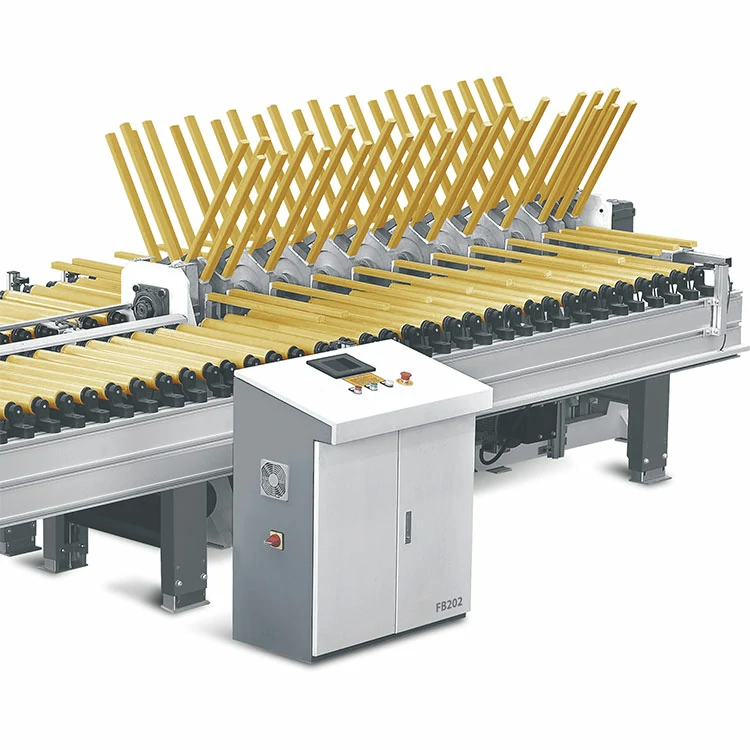
Overall Design: The FB202 features a robust steel frame structure integrated with roller conveyor tables and an automatic flipping mechanism, ensuring stable operation and high load capacity.
Control System: Equipped with a dedicated electrical control cabinet and intuitive control panel, it offers a straightforward interface for quick operator familiarization.
Modular Design: Seamlessly integrates with loading/unloading equipment, sanders, laminating machines, and other woodworking production lines to achieve full-line automation.
Innovation and Working Principle:
Working Principle: Workpieces are conveyed into the flipping machine via rollers. → The flipping mechanism lifts the panels. → Smooth flipping is achieved using a pneumatic system. → After flipping, workpieces continue to the following process.
Innovative Features:
Automated Flipping: Replaces manual panel flipping, reducing labor intensity and safety risks.
Flexible Handling: Accommodates plates of varying thicknesses (8–50mm) and widths (100–1200mm).
Line Integration: Directly interfaces with subsequent processes like coating, sanding, and veneering, minimizing material handling.
Machine name | Panel Flipper Machine |
Equipment type | FB 202 |
Workpiece length | 400-2400mm |
Workpiece width | 100-1200mm |
Thickness range of workpiece | 8-50mm |
Max. Workpiece weight | Max.50KG |
Store capacity | 4pcs |
Working speed | 4/min |
Air pressure | 0.3-0.6Mpa |
Power supply | 380V |
1. Sheet Feeding Stage
Sheets enter the FB202 via a roller conveyor line.
The motor-driven rollers ensure smooth and continuous movement of the workpiece to the flipping station.
The machine detects sheet dimensions (length/width/thickness) and stops or decelerates the sheet upon reaching the designated position.
Key Principle: Utilizes the roller conveyor and positioning device to feed the sheet into the flipping zone, guaranteeing precise positioning.
2. Flipping Preparation
Upon reaching the flipping station, the positioning device fixes the sheet.
Pneumatic clamping arms or gripping devices activate, securing the sheet to the flipping frame to prevent slippage or falling.
Configured to flip single or multiple panels (FB202 standard capacity: 4 panels).
Key Principle: Pneumatic systems secure panels, ensuring stability during flipping.
3. Flipping Action
Pneumatic cylinders/linkage mechanisms drive the flipping mechanism, rotating the clamped panel assembly.
Based on process requirements, the flipping angle can be adjusted to 90° or 180°.
The motion is smooth to prevent surface nicks or scratches on the panels.
Key Principle: Pneumatic power combined with mechanical linkages creates a lever effect, rotating the flipping frame to turn the panels over.
4. Flipping Completion & Output
Upon reaching the final orientation, the pneumatic clamping device releases the panel.
The flipped panel is conveyed via rollers to the following process (e.g., sanding, coating, veneering, stacking).
The entire process can be integrated with loading/unloading systems to form a continuous production flow.
Key Principle: Conveying resumes immediately after flipping completion, maintaining production line cycle times.


The structure of the bottom cutter shaft can be pulled out quickly, which results in a more convenient and secure replacement or adjustment of the cutter.
The working table is made of unique wear-resistant material, precision machined, with a bright surface and good accuracy, and wear-resistant.
They imported Schneider Electric to provide new energy for the equipment.
High-precision magnetic grating digital display, accuracy up to 0.01mm, direct input of the thickness of the processed wood automatic positioning.


The feeding mechanism can be fine-tuned up and down, and the lifting range can be up to 6mm to improve significantly the machining precision.
They are equipped with an upper and lower active feeding roller structure, feeding faster and smoother, and fitted with an overload protection mechanism.
Equipped with a short material processing device, it ensures smooth processing of short materials and improves wood utilization.
Imported automatic lubrication pump and forced lubrication of feeding parts with no oil protection function.


Bearing selection of imported brands: TR, NSK, SKF, FAG, SNR.
Short feed, feed roller holder unit (optional).
Automatic thickness setting and shell falling limit protection device.
The bed is made of resin sand casting, which is not easy to deform and has strong stability.
About linkyou
LINKYOU is located in Lunjiao, Shunde, Foshan, where China’s machinery manufacturing industry is developed. Since its establishment in 2008, we have focused on the research and development and manufacturing of a full range of furniture woodworking machinery equipment, integrating advanced technology, experience, and a group of excellent technical R&D personnel at home and abroad.
We not only provide high-quality furniture woodworking machinery and equipment but also provide customers with one-stop solutions, including whole plant planning, automated production line design, and production process optimization, to assist furniture companies in realizing automated production, improve production efficiency, reduce costs, and gain a more significant competitive advantage in the furniture market.
Data Support
Numbers Speak For Themselves

LINKYOU Advantage
LINKYOU has established a good reputation in furniture machinery and equipment and provides professional technical support and high-quality solutions for global furniture companies.
We will continue to uphold the concept of innovation, service, and professionalism and work hand in hand with customers to promote the progress and development of the furniture industry.
- Global Vision
- R&D strength
- Customized service
- Customer first
- Quality supply chain
- Continuous improvement
LINKYOU, since its establishment in 2008, has developed into a national high-tech enterprise, helping countless enterprises to realize automated production, solve the production planning of the whole plant, improve production efficiency, reduce costs, and gain a more significant competitive advantage in the furniture market.
So far, it has served the majority of glass, automation, furniture, and wooden door companies in more than 50 countries and regions worldwide and has won wide praise from customers.
We know that every enterprise has unique operating needs and production characteristics. Hence, our solutions are versatile and can be flexibly adjusted according to the specific circumstances of customers to ensure that the interests of customers are maximized.
In the future, LINKYOU will continue to be committed to technological innovation and quality service, to provide global glass and furniture companies with more efficient, more innovative, and environmentally friendly furniture machinery and equipment and solutions, and to work with customers to promote the progress and development of different industries.
LINKYOU has a professional service team that solves all aspects of the automated production line of the customer's entire factory, integrates woodworking machinery, glass machinery, and food machinery, and provides thoughtful pre-sales, in-sales, and after-sales service.:
Pre-sales Service:
On-sale Service:
After-sales service:
Before customers purchase our machinery equipment, we will provide comprehensive product information and consulting services.
After customers purchase our machinery equipment, we will provide high-quality on-sale services.
We know that machinery equipment plays an essential role in production, so we are committed to providing customers with high-quality after-sales service.
We are committed to answering all customer questions, including the working principle, performance characteristics, scope of application, and equipment price.
Ensuring timely and accurate product delivery and providing customers with detailed installation and use training so they can start and use our equipment smoothly.
We will provide fast and professional solutions according to customer needs and technical support requirements. No matter what problems or difficulties customers encounter, we will try our best to assist them in solving them.
At the same time, we will provide professional suggestions and solutions according to the specific needs of our customers to ensure that customers can make informed purchase decisions.
In addition, we will also offer professional technical advice and support to ensure that customers can make full use of the functions and advantages of the equipment.
At the same time, we will regularly maintain and inspect our customers’ equipment to ensure the long-term stable operation of the equipment.
were here to all your questions
It is the only place to get the perfect solution for all your industry needs.
Contact us:
Jelly Guan
Email:shundefengyue@163.com
Phone:+86 13702626203
1.What types of wood are suitable for the seven-axis four-side planer?
The seven-axis four-side planer is suitable for various hardwoods, softwoods, composite materials, and woodworking projects with deep wood cuts. It can handle both rough wood and precision processing requirements.
2.How to adjust the blades for optimal cutting performance?
Blade angles, positions, and heights should be adjusted according to the type and thickness of the wood being processed. Ensure the blades are sharp and aligned to avoid uneven cuts or damage to the wood surface.
3.What aspects should be considered for daily maintenance and checks on the seven-axis four-side planer?
Regular checks should be done on blade wear, and wood debris and impurities should be cleaned to ensure the feeding and dust removal systems are clear. Inspect the electrical, hydraulic, and transmission systems to ensure smooth operation.
4.What should I do if the machine breaks down?
If the machine breaks down, stop the machine immediately and disconnect the power. Check the troubleshooting steps in the user manual. If the issue cannot be resolved independently, contact a professional technician for repair.
5.How often should the blades of the seven-axis four-side planer be replaced?
The blade replacement frequency depends on the type of wood being processed, the blade material, and the usage frequency. Typically, blades should be checked and replaced regularly after extended use to maintain processing quality.
6.How to ensure safe operation of the machine?
Operators must wear appropriate personal protective equipment (such as safety glasses, ear protection, gloves, etc.). Ensure that the machine’s safety devices (such as emergency stop buttons, safety shields, etc.) are intact and always follow the operating procedures strictly.