
WOODWORKING MATERIAL HANDLING

Automatic Loaders & Stackers for Woodworking Lines

Plan loading, unloading, and stacking around your workpiece and production flow. Explore LINKYOU handling equipment for machine infeed, outfeed, and stack management, with configurations matched to material size, weight, surface condition, and line layout.
Workpiece-Based Selection

Loading & Unloading

Stack Planning

Line Layout Review

Boost Production Efficiency

Automate loading and stacking toimprove line throughput and reduce production bottlenecks

Reduce Labor & Handling

Minimize manual handling, lowelabor intensity, and improveworkplace safety.

Seamless Line Integration

Compatible with sanding, cutting.drilling, and woodworking equipment and lines.

Stable & Reliable Operation

Engineered for continuous operationwith high stability and long-term performance.

“What Does a Loader and Stacker System Do?

A loader supplies workpieces to a machine or conveyor. An unloader receives them after processing, while a stacker arranges them into a defined stack. The equipment and sequence depend on the handling task; no single unit is assumed to perform every function.

Loading & Destacking

Feed the workpieces from the stack or feed station to the next process.

Unloading & Transfer

Receive processed workpieces and move them to the next defined position.

Stacking & Collection

Arrange outgoing workpieces according to the required stack or collection pattern.

Explore LINKYOU Loading and Stacking Equipment

Browse the equipment below to find a starting point for your handling task. Open the product details or share your workpiece and layout requirements to review the appropriate configuration

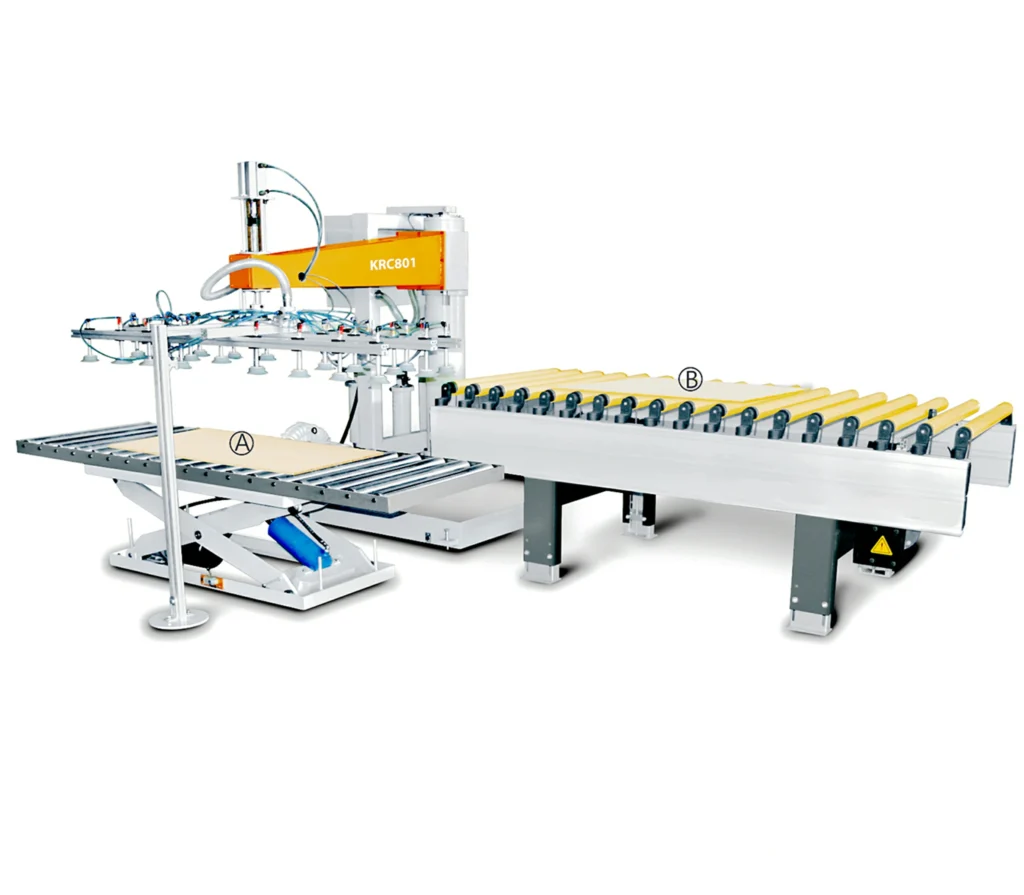
Single Arm Loader & Stacker

KRC801 / KRC810

A single-arm unit for transferring suitable panels between a supply position, conveyor, and designated loading or stacking point. Review vacuum contact, transfer direction, and working height against your panel and line requirements.

Automatic stacker with a roller support table and overhead handling assembly

Automatic Stacker

KSR702

Explore a stacking unit for organizing workpieces at the collection stage of a woodworking process. Confirm the incoming presentation, support arrangement, stack format and connection to the upstream equipment

Gantry handling equipment with an overhead vacuum head above panel stacks and roller tables

Gantry Loader & Stacker

LSC58-3

Review a gantry-type handling solution designed to transport suitable workpieces between designated feeding, conveying, and stacking locations. Adjust the travel area, lifting configuration, and workstation layout according to project requirements.

Match Handling Functions to Your Production Task

Define what must move, where it starts, and where it needs to arrive. The functions below are project requirements to review, not a list of standard features included with every machine.

Pick-Up or Separation

Review how workpieces are presented and whether they must be separated individually or handled as a confirmed layer.

Feeding & Alignment

Define the reference edge, presentation height, and orientation required by the receiving machine.

Transfer Direction

Specify the start and destination positions and any required change in direction.

Unloading & Buffering

Review how parts leave the process and what happens when the next station is unavailable.

Stack Formation

Define the stack height, alignment, layer arrangement, and any required separators.

Turning a workpiece within its plane and turning it over to expose the opposite face are different tasks. Specify the required motion during layout review.

Need Help Choosing a Handling System?

Send a workpiece photo, its size and weight, and the task you want to automate. You can start with the requirement even if you do not know the machine type.

Where Loading and Stacking Systems Fit

Review material handling at the points where workpieces enter, leave, or move between processes. The examples below describe project tasks; suitability depends on workpiece contact, timing, and the connected equipment.

Sanding Line Infeed & Outfeed

Plan how suitable panels are presented to the sander and collected after processing, including dust and surface-contact requirements.

Sawing & Milling Line Handling

Match panel presentation, orientation and discharge to the selected cutting or milling process.

Transfer Between Processes

Move workpieces between defined stations while coordinating receiving height, orientation and readiness.

End-of-Line Stacking

Organize finished workpieces for collection, further processing or packaging according to the agreed stack pattern.

How to Select a Loader and Stacker System

Selection starts with the workpiece and the full handling cycle, including how material arrives and how completed stacks leave. Share the following information before equipment size, contact method, and layout are recommended.

Selection Factor

What to provide

Decision supported

Dimensions & Weight

Minimum and maximum length, width, and thickness; item weight and items per transfer

Handling the envelope and transferring the load

Material & Surface

Material, flatness, porosity, texture, coating, and dust

Contact method and surface protection

Incoming Presentation

Individual parts, layers, or stacks; separators and sticking

Separation and presentation

Task & Orientation

Start, destination, reference edge, and required orientation

Transfer path and interfaces

Required Rate

Parts per minute or shift, peak demand, and waiting conditions

Cycle, buffer and line matching

Stack Specification

Pallet size, maximum stack height, total stack weight, and layer pattern

Support, stack formation and changeover

Layout

Space, transfer heights, vehicle access, and machine drawings

Installation and transfer zones

Workpiece payload and lift-table or full-stack capacity are different limits. State the item weight and stack weight separately. Conveyor speed also does not establish the number of completed pick-and-place cycles.

Plan the Installation and Line Interfaces

A practical layout must account for the equipment, workpiece travel, and access around it. Review utilities and machine interfaces together so loading, processing, and collection can operate in the agreed sequence.

Electrical & Air Supply

Confirm voltage, frequency, connected load, and any compressed-air requirements.

Vacuum or Contact System

For vacuum equipment, review the vacuum source and surface compatibility, and specify alternative contact methods where applicable.

Space & Support

Review travel envelope, ceiling clearance, floor suitability, anchoring, and maintenance access.

Machine Handover

Define receiving height, position, timing, and the signals required between machines.

Access & Changeover

Plan pallet replacement, stack removal, operator access, and the agreed restart sequence.

Environment & Protection

Review dust, surface sensitivity, noise, and the guarding or interlocks required for the installation.

Have a Line Layout or Handling Target?

Share the workpiece size and weight, transfer height, required rate, and a sketch of the loading or stacking area. A simple drawing is enough to begin the layout discussion.

How Automated Workpiece Handling Is Organized

A handling cycle begins with a known supply position and ends at an agreed receiving position. The selected equipment supports, grips, or carries the workpiece using the method suited to its shape, weight, and surface.

Conceptual handling sequence

Conceptual gantry handling system with a wood panel ready on the supply conveyor

Present the Workpiece

Establish a repeatable supply position and the condition needed for transfer.

Conceptual handling gripper supporting and lifting a wood panel above the supply conveyor

Establish
Contact

Match the support or gripping arrangement to the workpiece and required surface protection.

Conceptual gantry transferring a supported wood panel toward the receiving conveyor

Transfer and
Place

Move within the defined operating area and present the workpiece in the required position and orientation.

loader stacker 04 release reset

Release and
Prepare

Complete the handover and prepare for the next cycle according to the configured sequence.

Vacuum handling is one configuration, not a property of every loader or stacker. The surface condition and available contact area must be reviewed when suction is used.

Connect Loading, Processing and Stacking

Plan handling as part of the complete production line, from material presentation to collection after processing. Loading and stacking may use separate units; the final equipment and sequence depend on the project.

Automated wood sawing and milling line with six numbered stages from loading to unloading and stacking

Conceptual line layout. Processing machines, conveyors, lift tables, and handling units are included only as specified in the project scope.

1. Present Material

Supply stock at the defined loading or destacking position.

2. Load and Transfer

Move eligible workpieces to the infeed position using the selected handling method.

3. Handover to the Process

Present workpieces at the required height, orientation, and timing.

4. Process the Workpiece

The connected woodworking machine carries out the specified operation.

5. Receive and Stack

Collect processed parts and arrange them according to the confirmed outfeed and stack plan.

6. Remove the Stack and Repeat

Manage completed stacks and replenish supply according to the agreed changeover plan.

Support for a Defined Handling Configuration

Use a configuration review to connect workpiece requirements with equipment selection, layout, and acceptance criteria. The result should be a clear scope for the proposed handling system.

Workpiece Review

Define size, weight, material, and surface-contact requirements.

Task Definition

Separate loading, unloading, transfer and stacking needs.

Layout Planning

Review transfer paths, surrounding equipment and access.

Cycle Coordination

Match handling demand with processing and stack-change conditions.

Acceptance Review

Agree representative workpieces and the checks required for acceptance.

Technical Information

Clarify the supplied configuration, options, and installation information.

Questions About Woodworking Loaders and Stackers

These answers cover the key decisions to make before selecting a handling system. Use the product details and confirmed proposal for equipment-specific capabilities and limits.

Do I need a loader, an unloader or a stacker?

Start with the task. A loader supplies the process, an unloader receives its output, and a stacker builds the required stack. One project may need several tasks, but they are not automatically performed by the same unit.

Compatibility depends on geometry, weight, contact area, and surface condition. Specify whether the material is porous, rough, coated, perforated, warped, or fragile, and verify the proposed handling method with representative samples.

Provide the weight of each workpiece, the number moved per transfer and the total stack load. The handling unit, lift table and conveyor may have different rated limits; none should be inferred from another component’s capacity.

State the required workpieces per minute or per shift and the peak demand. Include travel, pick-up, placement, waiting, replenishment, and stack changes. A conveyor speed or unloaded arm movement alone does not establish completed handling output.

No. Changing the travel direction, rotating within the plane, and reversing the exposed face are different requirements. Show the start and end orientation on a sketch so the correct equipment can be reviewed.

Integration requires a review of transfer heights, workpiece presentation, cycle timing, and control interfaces. Share the machine layout and available interface information; do not assume a standard protocol or universal connection.

These depend on the project scope. Specify pallet dimensions, stack patterns, separators and the acceptable interruption during changeover. Any additional stations or handling units must be identified in the proposal.

Send workpiece photos, size and weight ranges, the handling task, target rate, stack requirements and a sketch showing equipment positions and heights. You can start with the information available and add technical details during review.

Tell Us About Your Loading and Stacking Project

Share the workpieces you handle and where they need to move. Photos, dimensions, weight, and a simple layout help define suitable equipment and the next technical questions.

What to Include in Your Inquiry

  • Workpiece & Weight: Material, minimum and maximum dimensions, and weight per workpiece.

  • Handling Task: Loading, unloading, transferring, or stacking, including the pickup and receiving positions.

  • Production Target: Required pieces per minute or handling cycle, plus the current line speed if available

  • Line & Site Conditions: Connected machines, feed direction, conveyor height, and available installation space.

Find the Right Loading & Stacking Solution

Phone

+0086 13702626203

Email

shundefengyue@163.com

WhatsApp

+ 0086-13702626203

Address

Shunde, Foshan, Guangdong, China

Explore Equipment Around Your Handling Process

Loading and stacking support the flow around processing equipment. Explore the related series for the required machining or turning task, then review the interfaces as part of the line layout.

VK-B630B double-sided planer with stepless speed regulation for fixed-thickness wood preparation

Planer & Saw Machine Series

Compare wood planers, molders, rip saws, and planer-saw machines for solid wood preparation, profiling, and sizing.

LINKYOU VK-J100 optimizing cut-off saw for crosscutting solid wood to required lengths

High-Speed Cut-Off Saw Series

Review high-speed cut-off saws for crosscutting solid wood to length and, where configured, supporting length optimization or defect removal.

LINKYOU FB204 barrel turner for rotating wood panels between production processes

Automatic Flipper Machine Series

Select horizontal or vertical turning and transfer equipment according to workpiece dimensions, weight, orientation, and the next operation.

LINKYOU SW350DM-W4C5 four-sides sander for sanding long solid wood components

Sander Machine Series

Explore wide-belt, profile, and four-side sanding machines for calibration and surface finishing after the relevant planing or sawing stage.

Scroll to Top

LINKYOU · EQUIPMENT INQUIRY

Start with your project

Share the essentials first. You may add drawings, photos, or more technical details when they are available.

Share your requirement

Machine, application and project goal

Add details if available

Workpiece, layout, drawing or photos

Discuss the next step

Our team reviews your inquiry details

For a line-layout review

Add panel size, thickness, weight, conveyor direction, and any required 90 ° or 180° transfer.

Tell Us About Your Project

Fields marked with * are required.