
PLANING · MOULDING · RIPPING
Industrial Wood Planers & Rip Saws for Solid Wood Processing
Compare machinery for top-and-bottom thickness planing, four-side planing and profiling, straight-line edge ripping, multi-blade ripping, and four-side planing with horizontal resawing. Start with the operation you need, then verify the workpiece, tooling, capacity, and installation requirements.
Four Side Moulder
Double Side Planer
Multi Rip
Saw
18+
Years
Industry Experience
Reliable
Quality
CE Certified
Global
Service
100+ Countries
Expert
Support
Quick Response
- Quick Answer
“What Machines Are Included in the Planer & Rip Saw Series?
LINKYOU’s planer and rip saw range covers machines for surface preparation, profiling, and longitudinal cutting of solid wood. A double-sided planer machines the top and bottom faces; a four-side planer or molder processes four faces and can create profiles; a straight-line rip saw makes one controlled lengthwise cut; a multi-rip saw makes several lengthwise cuts in one pass; and the VK-L9616SM/VK-L9620SM combine four-side planing with horizontal resawing. The correct choice depends on the required operation and workpiece—not the category name alone.
Need uniform board thickness?
Start with a double-sided planer to machine the upper and lower faces in a single pass.
Need four finished faces or a profile?
Compare a four-side planer or molder according to the finished section, spindle arrangement, and tooling.
Need one straight lengthwise cut?
Use a straight-line rip saw for edge straightening or one operator-selected width cut per pass.
Need several strips in one pass?
Use a multi-blade rip saw when the blade-and-spacer arrangement can be set for the required strip widths.
Need plan plus horizontal resaw?
Review the VK-L9616SM or VK-L9620SM for four-side preparation followed by opposed left/right resawing.
- Machine Range and Key Capabilities
Choose a Machine by the Operation You Need
Each machine family performs a different preparation or cutting task. Use the cards below to identify the closest process, then open the model page to verify the working dimensions, feed speed, tooling, utilities, and standard or optional equipment.

Double-Sided Planer Machine
Machine the upper and lower faces of a board in one feed path for fixed-thickness preparation. Choose the 470 mm or 630 mm working-width family according to the widest approved board, then confirm the cutter-spindle configuration, material removal, and installation conditions.
Best for: Top- and bottom-planing before ripping, profiling, or sanding.

Dual-Spindle Multi-Blade Rip Saw
Use upper and lower saw shafts to make multiple longitudinal cuts in one feed pass. The blade-and-spacer arrangement defines the strip widths, while actual output also depends on timber condition, kerf, feed setting, and material handling.
Best for: Repeated production of multiple solid-wood strips.
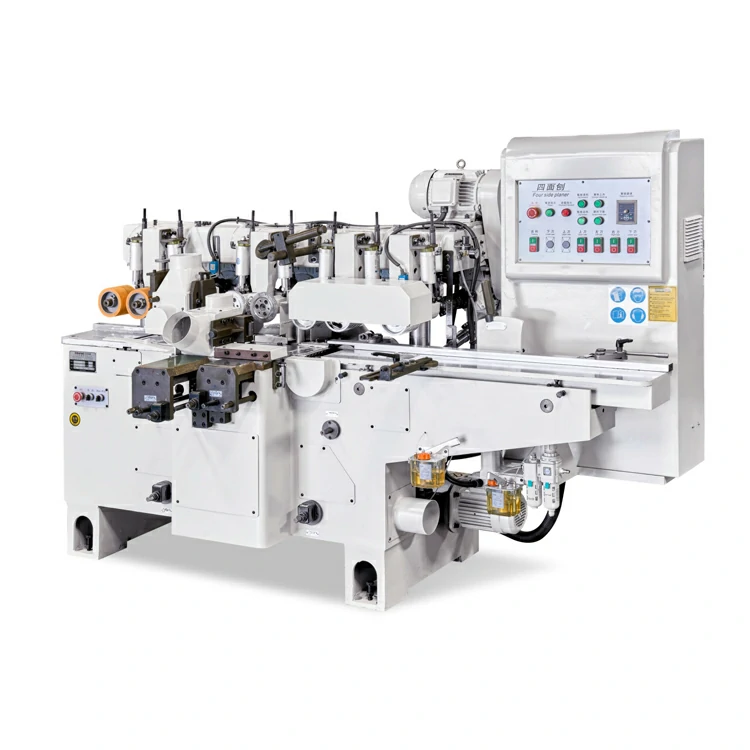
Four-Axis Four-Side Wood Planer
Machine the top, bottom, left, and right faces in one through-feed process. This model is a starting point for S4S preparation and suitable profiles within its approved tooling and workpiece range.
Best for: Four-face preparation of solid-wood strips and components.
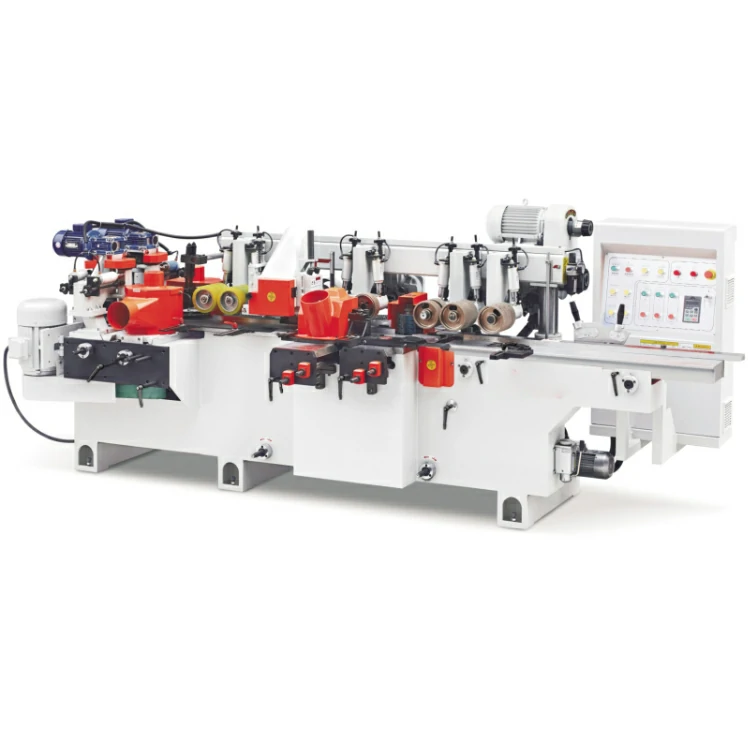
Four-Side Planer Saw Machine
Combine four-side planing and horizontal resawing in one feed pass. The outer faces are prepared before the opposing saw units divide the suitable timber through its thickness. Newly sawn faces may require a later finishing process.
Best for: Repeated preparation of thinner boards from suitable solid-wood sections.

Straight-Line
Rip Saw
Use a bottom-mounted single blade and powered chain feed to make one controlled lengthwise cut per pass. It is intended for edge straightening or width ripping—not automatic defect scanning or crosscutting to length.
Best for: Establishing a straight edge or selected board width.

Seven-Spindle Four-Side Wood Planer
Use additional cutter positions for four-side planing and more involved profiling tasks. Select the machine from the finished profile drawing, working section, spindle sequence, tooling, and required feed conditions.
Best for: Doors, frames, moldings, and profiled solid-wood components.
- Machine-Type Comparison
Planer vs Moulder vs Rip Saw: Which Process Fits Your Job?
Choose the machining action before comparing motor power or price. The table separates surface preparation, profiling, single ripping, multiple ripping, and horizontal resawing to avoid evaluating unrelated machines as substitutes.
Machine type
What it does
Typical result
Choose it when
Confirm before quotation
Double-sided planer
Machines top and bottom faces in one feed path
Board prepared to a consistent thickness range
Both broad faces need planing; edges are handled elsewhere
Incoming/finished thickness, width, length, removal per pass, cutterhead, finish
Four-side planer /moulder
Machines four longitudinal faces and may profile approved sections
S4S or profiled component
Top, bottom and both edges must be machined in one throughfeed process
Finished profile drawing, spindle sequence, tooling, feed, minimum length
Straight-line rip saw
Makes one controlled lengthwise cut per pass
Straight edge or selected width
One edge or width cut is required and the operator selects the cut line
Board condition, width/thickness/length, blade, pressure, and feed setting
Multi-blade rip saw
Makes several lengthwise cuts in one pass
Multiple strips or blanks
Repeated strip widths justify a blade-and-spacer setup
Cutting pattern, kerf, spacer arrangement, timber thickness, handling
Four-side planer saw
Planes four outer faces, then resaws horizontally through the thickness
Prepared thinner boards with newly sawn faces
The same workpiece needs four-face preparation and horizontal resawing
Incoming section, target board thicknesses, kerf, tooling, and downstream finishing
Ripping follows the workpiece length. Crosscutting cuts across the workpiece to produce a required length. For length optimization or defect crosscutting, use the High-Speed Cut-Off Saw Series rather than a rip saw.
Not Sure Which Machine Type Fits Your Process?
Tell us your material, incoming dimensions, and required operation. We can help you compare the relevant planer, molder, or rip saw family before providing a quotation.
- Working Principle and Production Flow
How Planing and Ripping Fit into a Solid Wood Process
Not every production line uses every machine shown on this page. After the incoming timber is checked, it is fed steadily through the machine selected for the required operation: planing and profiling, longitudinal ripping, or combined four-side preparation and horizontal resawing. The processed workpiece is then inspected before moving to the next operation.

Conceptual workflow—final machine selection and process sequence depend on the workpiece and confirmed project requirements.
Inspect the Incoming Timber
Record the wood species, moisture condition, visible defects, and incoming length × width × thickness. Separate any material that falls outside the approved processing range.
Feed and Position the Workpiece
The feeding and guiding system moves the workpiece steadily through the selected machine. Correct positioning and stable feeding help maintain consistent machining results.
Select the Required Machining Route
Planing & Profiling
Use a double-sided planer for the upper and lower faces, or a four-side planer/moulder when all longitudinal faces or profiles require machining.
Longitudinal Ripping
Use a straight-line rip saw for one longitudinal cut or a multi-rip saw for several parallel strip cuts.
Combined Processing
Use a compatible planer-saw machine for four-side preparation followed by horizontal resawing.
Inspect the Processed Output
Check the finished dimensions, surface condition, and cut quality against the requirements of the next process. Allow for any material that must be removed during later planing or sanding.
Transfer to the Next Process
Transfer accepted workpieces to crosscutting, sanding, further machining, or stacking according to the confirmed production plan. Related conveyors, sanders, loaders, and stackers are separate project items unless included in the agreed line configuration.
- Applications
Industrial Planing and Ripping Applications
This range is intended primarily for solid-wood preparation. Match the machine to the specific machining step and confirm the material, profile, dimensions, and finish requirements before treating an application example as approved for compatibility.
Furniture Component
Production
solid wood to size for high-quality
furniture parts with precise dimensions.
Wood
Door
Manufacturing
materials with consistent cutting
quality for smooth
assembly.
Flooring and Moulding
Production
moldings, baseboards, and
trim components.
Solid
Wood
Preparation
further machining and
structural applications
- SELECTION GUIDE
What Information Is Needed to Select the Right Machine?
Accurate selection starts with the material and required finished part—not just a machine name. Share the following information so LINKYOU can compare the process, model range, tooling, and installation conditions before providing a quotation.
Selection Factor
What to Consider
Key Points
LINKYOU Recommendation
Material Type
Solid wood, MDF, softwood, hardwood, engineered wood, etc.
Different materials require specific blade types, cutting speeds, and pressure control
We configure the most suitable machine based on your material.
Workpiece Size
Thickness, width, length, and range of raw boards.
Determine the maximum and minimum processing range and feeding stability.
We recommend the optimal working range for your needs.
Processing Step
Planning, ripping, crosscutting, multi-rip, trimming, etc.
Clarify your process flow and the functions required at each station.
We provide the most efficient process, solution, and machine configuration.
Capacity Target
Daily output, shifts per day, and line speed.
Match motor power, feeding speed, and automation level to your target.
We design a production capacity solution tailored to your goals.
Factory Layout
Available space, material flow direction, and equipment layout
A reasonable layout improves safety, efficiency, and operability!
We offer layout planning and line integration support.
Future Upgrade
Scalability, automation upgrade, and line expansion
Consider future needs for additional modules or smart upgrades.
We provide modular solutions for easy future expansion.
Infeed
Automatic infeed conveyor
Planing
Top & bottom planing
Sawing
Ripping / crosscut sawing

- Model Families and Starting Specifications
Compare Model Families by Their Main Working Range
Use this summary to identify a starting model family. The linked product pages contain fuller technical tables. Final suitability still requires confirmation of the workpiece, tooling, standard or optional scope, utilities, and installation layout.
Machine family
Model(s)
Selection-level range
Main selection trigger
Double-sided planer
VK-B470B / VK-B630B
10–470 or 10–630 mm working width; 9–200 mm thickness; 7–13 m/min feed
Required board width and cutter-spindle configuration
Four-axis four-side planer
VK-B416B
25–160 mm working width; 8–100 mm thickness; 5–36 m/min feed
Four-face preparation within the approved tooling/profile
Seven-spindle four-side molder
VK-B718D
25–180 mm working width; 8–130 mm thickness; 5–40 m/min feed; 580/300 mm minimum length (intermittent/continuous)
Finished profile, spindle sequence, tooling, and required section
Four-side planer saw
VK-L9616SM / VK-L9620SM
30–160 or 30–200 mm working width; 10–120 mm thickness; 8–20 m/min feed; 600 mm minimum length
Incoming width and target horizontal-resawed board thickness
Straight-line rip saw
VK-J163B
Up to 460 mm cutting width; 10–90 mm cutting thickness; 230 mm minimum length; 10–33 m/min feed
One controlled longitudinal cut per pass
Dual-spindle multi-blade rip saw
VK-J9420 / VK-J9430
Up to 200 or 300 mm cutting width; 15–120 mm cutting thickness; 450 mm minimum length; 5–12 m/min feed
Required cutting width and blade/spacer pattern
Specification note
Values are category-page selection references taken from the current LINKYOU product pages and the supplied catalog information. Reconfirm them against the current technical proposal and supplied configuration before publication or quotation. A maximum feed speed does not guarantee a production rate for every material.
Send Your Workpiece Details for a More Accurate Recommendation
Share the minimum and maximum length × width × thickness, finished section, required capacity, and any available drawings or photos. We will use this information to identify a suitable starting model and the items that still require confirmation.
- LINE INTEGRATION
Plan Infeed, Outfeed and Downstream Integration
A planer or rip saw may operate as a stand-alone machine or as one station in a larger solid wood processing line. Select only the infeed, outfeed, sanding, transfer, or stacking modules required for the actual workpiece. Final integration should be reviewed against workpiece dimensions and condition, working height, feed speed, target capacity, available space, safety requirements, and control interfaces.

Infeed and Alignment
Confirm whether the workpiece will be presented manually, by a narrow-stock loader, or by a roller conveyor. Review orientation, material condition, minimum length, working height, and feed rhythm before selecting an automatic infeed module.
Outfeed Support and Separation
Provide continuous support for the longest workpiece and define how boards, strips, or resawn sections will be separated and collected. Automatic separation is a project-specific option and is not included with the main machine.
Optional Sanding and Surface Finishing
Add sanding only when the planed or newly sawn surfaces require further finishing. Match the sanding machine to the processed faces, workpiece dimensions, required finish, and line speed.
Loading, Stacking and Transfer
Evaluate conveyors, cross-transfer units, or stackers according to workpiece flatness, size, weight, cycle time, and stack pattern. Vacuum handling should be confirmed before it is proposed for rough or irregular solid wood.
Planning Infeed, Outfeed or a Complete Processing Cell?
Share your workpiece, target cycle, available floor space, working height, and connected equipment. We can review the required conveyors, loading, transfer, separation, or stacking units as part of the project scope.
- BUYER FAQ
Frequently Asked Questions About Wood Planers and Rip Saws
These answers clarify the main differences in processes and the information required before a model can be recommended. Final machine suitability depends on the actual material, dimensions, tooling, and site conditions.
What is the difference between a double-sided planer and a four-side planer?
A double-sided planer machines both the upper and lower faces of a board in a single pass. A four-side planer or molder also machines the two longitudinal edges and may create profiles with suitable tooling. Choose based on the faces and the final section that must be produced.
What is the difference between a straight-line rip saw and a multi-rip saw?
A straight-line rip saw uses a single blade to make a controlled lengthwise cut per pass, commonly for edge straightening or width ripping. A multi-rip saw uses several blades to make multiple lengthwise cuts in a single pass. Its output widths are determined by the approved blade-and-spacer setup.
Is a four-side planer saw the same as a multi-rip saw?
No. The VK-L9616SM/VK-L9620SM combine four-side planing with horizontal resawing through the thickness of suitable timber. The VK-J9420/VK-J9430 use upper and lower multi-blade shafts to make multiple longitudinal strip cuts. The cutting direction and intended output are different.
Can one machine complete both planing and cutting?
The four-side planer-saw family combines four-face preparation and horizontal resawing in one feed pass. It does not replace every planing, longitudinal ripping, or crosscutting process. Confirm the required faces, cutting direction, output sections, and downstream finish before selecting it.
Can these machines process MDF, plywood or particleboard?
Do not assume engineered-panel compatibility across the whole category. This page focuses on solid-wood processing. If an engineered material must be processed, send its construction, density, dimensions, and required result so that compatibility, tooling, and dust-control requirements can be reviewed for a specific machine.
Is ripping the same as crosscutting?
No. Ripping follows the length of the workpiece, while crosscutting cuts across the width to produce the required length. For length optimization or defect removal, review the LINKYOU High-Speed Cut-Off Saw Series.
Can a planer or rip saw connect to an automated line?
Possible integration depends on workpiece size and weight, cycle time, transfer height, orientation, floor space, and the control scope of each station. Conveyors, loaders, stackers, and separation systems should be confirmed as separate line components unless they are explicitly included in the proposal.
What should I send before requesting a quotation?
Send the material, moisture condition (if known), incoming and finished dimensions, required operation, profile or cutting-pattern drawing, capacity target, local voltage and frequency, dust-extraction details, installation space, and photos of the current process, where available.
What utilities should be checked before installation?
Requirements vary by model. Confirm electrical voltage, frequency, and phase; compressed-air pressure and consumption, where applicable; dust-outlet sizes and extraction capacity; machine footprint; infeed/outfeed space; operator access; and maintenance clearance.
- Technical Inquiry
Tell Us About Your Solid Wood Process
Share your material, incoming dimensions, required finished section, and production target. A drawing or a clearly labeled photo helps LINKYOU compare the relevant machine type and identify the specifications, tooling, and site conditions that must be confirmed before providing a quotation.
Material and incoming L × W × TFinished section or cutting patternCapacity target and connected equipment
Get a Machine Recommendation
Phone
+0086 13702626203
shundefengyue@163.com
+ 0086-13702626203
Address
Shunde, Foshan, Guangdong, China
Build the Next Stage of Your Woodworking Line
Planing and ripping are often part of a larger production flow. Review the next operation only after the workpiece, process order, and required transfer method have been defined.

Sander Machine Series
Explore wide-belt, profile, and four-side sanding machines for calibration and surface finishing after the relevant planing or sawing stage.

High-Speed Cut-Off Saw Series
Review high-speed cut-off saws for crosscutting solid wood to length and, where configured, supporting length optimization or defect removal.

Loader & Stacker Series
Compare automatic loading, unloading, and stacking systems for reducing manual handling and connecting machines within a production line.

Automatic Flipper Machine Series
Select horizontal or vertical turning and transfer equipment according to workpiece dimensions, weight, orientation, and the next operation.