
Industrial Wood Cross-Cutting
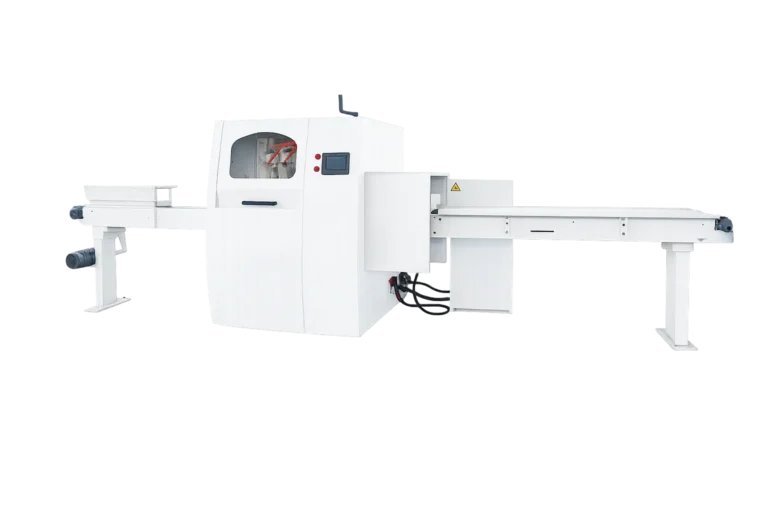
VK-J100/J200 Optimizing Cross-Cut Saw for Wood
Optimize fixed-length cutting, remove marked defects and complete order-based cutting with servo feeding at speeds up to 100 m/min.
- Max. Cutting Section: 75 × 125 Mm Or 50 × 180 Mm
- Workpiece Range: 5–70 Mm Thick And 10–120 Mm Wide
- Cutting Strategies: Yield, Value, Grade, Length, Quantity, And Defect Removal
- Quick Answer
“What Is an Optimizing Cross-Cut Saw?
The VK-J series combines a cutting list, optimization logic, servo-controlled feeding and bottom-up cross-cutting. Depending on the selected mode, it calculates length combinations for yield, value, grade or order quantity. For defect removal, the operator inspects the wood and marks visible defects; the machine detects the fluorescent marks, positions the workpiece and cuts at the marked locations.
100 m/min
Maximum feed speed
455 mm
Saw blade diameter
6 + 6
Top and bottom rollers
16 kW
Total installed power
- Production Benefits Buyer Outcomes
Production Benefits for Different Cutting Priorities
The VK-J series combines cut-list optimization, fluorescent-mark detection and servo-controlled feeding to make better use of each workpiece. It helps manufacturers remove marked defects, fulfill production orders and maintain a stable workflow during repeated high-speed cross-cutting.

Use More of the Board
Yield optimization calculates a suitable combination of required lengths from the available cutting list.

Remove Marked Defects
Fluorescent mark detection supports targeted removal of knots, tear-outs, rot and other operator-identified defects.

Match the Order
Quantity and order modes calculate length combinations and track completion across specified sizes.

Stabilize High-Speed Feeding
Six top rollers, six bottom rollers and side-pressure feeding maintain workpiece contact during transport and positioning.
- Working Principle
How the VK-J Optimizing Cross-Cut Saw Works
The VK-J series turns each cutting task into a controlled six-step workflow. After the operator enters the required lengths, quantities and optimization rules, the workpiece is measured and inspected, with defect boundaries marked when removal is required. The control system then reads the reference marks, calculates the cutting sequence and positions the material through servo-controlled feeding. A 455 mm saw blade rises from below to complete each cross-cut before the finished parts and residual sections are discharged for downstream handling.

Set the Cutting Task
Enter or select the required lengths, quantities, values, and grade rules for the current job.

Inspect and Mark
When defect removal is required, the operator checks the wood and marks the defect boundaries with a fluorescent line.

Read and Feed
The detection and feeding system reads the reference marks and transports the workpiece to the calculated position.

Calculate the Sequence
The controller chooses a cutting sequence according to the selected yield, value, grade, length or order strategy.

Cross-Cut from Below
The 455 mm saw blade rises through the workpiece to perform the programmed cross-cut.

Discharge the Results
Usable fixed-length parts and removed defect or residual sections continue to the specified downstream handling process.
- Available Cutting Logic
Cutting Strategies for Different Production Priorities
The VK-J series supports multiple cutting strategies for different production priorities. Operators can select the appropriate cutting logic according to material yield, assigned value, grade, required length, order quantity, or defect-removal needs. The control system then calculates the cutting sequence from the active cut list, helping each workpiece better match the specified production task.
Optimal Yield Cutting
Calculates a suitable combination of fixed lengths from the cutting list to improve usable wood yield.
Optimal Value Cutting
Uses the assigned values in the cutting list to prioritize the combination with the highest calculated material value.
Grade Sorting Cutting
Supports up to 200 lengths and eight grades, including downgrading suitable residual material to a lower grade and length.
Defect Removal
Cuts out operator-marked sections containing knots, tear-outs, rot or other visible defects.
Longest-Length Cutting
Prioritizes the longest required length available in the active cutting list.
Joint Cutting
Plans residual and shorter sections for subsequent finger-joint use, helping recover material for the next process.
Quantity and Order Cutting
Calculates length combinations according to the required quantities and completes tasks across specified lengths.
Optional Configuration
Width-Based Cut-List Selection
Selects the matching program from up to 16 stored cutting lists according to the entered or detected material width. This changes the cross-cut program; it does not rip the material to width. Confirm model compatibility and the detection method before providing a quotation.
- Key Features Key Machine Details
Key Machine Features for Positioning and Feeding
The following machine details show how the VK-J series controls cutting reference, workpiece feeding and cross-cut execution. From mark recognition and side-pressure guidance to the bottom-up saw unit, each mechanism performs a specific role in keeping the material referenced and moving it toward the programmed cutting position.

Red Laser Cutting Guide
The infrared reference line helps the operator check and calibrate the intended cutting position.

Bottom-Up Cross-Cutting
The saw blade rises from below the workpiece to execute the programmed cross-cut inside the enclosed saw unit.

Side-Pressure
Feeding
A rubber-wheel side-pressure device keeps the workpiece referenced during automatic feeding and positioning.

Fluorescent Mark Alignment
The brochure states a fluorescent mark-to-cut alignment deviation of less than 0.1 mm. This is not the finished-part length tolerance.
- Model Comparison and Parameters VK-J100 vs VK-J200
VK-J100 and VK-J200 Model Comparison and Parameters
VK-J100 and VK-J200 share the same listed cutting section, feeding speed and main power configuration, but they are designed for different material-flow requirements. Compare the incoming workpiece length, machine footprint, outfeed sorting configuration, and supported optimization modes to identify the model that better matches your production line.
Specification
VK-J100
VK-J200
Max. cutting section
75 × 125 mm or 50 × 180 mm
75 × 125 mm or 50 × 180 mm
Cutting thickness
5–70 mm
5–70 mm
Cutting width
10–120 mm
10–120 mm
Incoming workpiece length
200 mm minimum; no machine-defined maximum
350–6300 mm
Max. feeding speed
100 m/min
100 m/min
Saw diameter / speed
455 mm / 4000 rpm
455 mm / 4000 rpm
Saw shaft power
5.5 kW
5.5 kW
Servo feeding power
4.5 kW
4.5 kW
Saw lifting power
4.5 kW
4.5 kW
Total installed power
16 kW
16 kW
Voltage
380 V / 50 Hz
380 V / 50 Hz
Overall size
6000 × 1400 × 1550 mm
18000 × 1400 × 1550 mm
Weight
1800 kg
2500 kg
Top / bottom rollers
6 / 6
6 / 6
Outfeed sorting ejectors
—
18
Documented mode focus
Defect removal, order cutting and size cutting
Yield, length, order, quantity, defect removal and zero-waste cutting
Selection cue: choose by incoming length, required optimization mode, and downstream sorting needs. For VK-J100, maximum incoming length depends on the infeed/outfeed layout and available factory space. Confirm the final cut-length tolerance by cutting a sample. Air pressure, air consumption, dust outlet size, and airflow must be confirmed from the final machine configuration
Final machine specifications may vary according to the confirmed configuration. Please contact LINKYOU to confirm voltage, motor configuration, sanding unit setup, and production requirements before ordering.
- Suitable Applications

Suitable Wood Components and Production Applications
The VK-J series is designed for repeated cross-cutting of straight solid-wood components where specified finished lengths, defect removal or cut-list allocation are required. The applications below represent typical production uses; final suitability should be confirmed according to the wood species, workpiece condition, required tolerance and downstream process.
Furniture Component Blanks
Moulding
Blanks
Door And Window Stock
Flooring Components
Pallet And Packaging Stock
Finger-Joint Preparation
- Selection Checklist
Help Us Recommend the Right VK-J Configuration
To recommend a suitable VK-J model and configuration, we need to understand your material, cutting requirements, production target, and line conditions. Share the information below and, where possible, provide representative workpieces and a typical cutting list for technical review and sample-cut validation.
Material and Workpiece
Wood species, moisture content, surface condition, and the minimum and maximum width, thickness, and incoming length of the workpieces.
Cutting Requirements
Required finished lengths, quantities, grades or priorities, defect types, fluorescent-marking method, target output, required cut tolerance, and acceptable residual length.
Line and Site Conditions
Infeed and outfeed arrangement, required sorting points, downstream equipment, available voltage, compressed-air conditions and dust-extraction connection.
Sample-Cut Validation
Where possible, provide representative workpieces and a typical cutting list. Final cutting performance and finished-length tolerance should be confirmed by testing your actual material and production rules.
- Frequently Asked Questions
What buyers should confirm before ordering
The questions below clarify the VK-J series’ optimization logic, defect-marking workflow, model differences and processing boundaries. Reviewing these points before ordering can help buyers distinguish standard documented functions from optional configurations and identify the technical details that still require confirmation for a specific project.
What does “optimizing” mean in an optimizing cross-cut saw?
It means the controller arranges cuts according to a selected rule—such as yield, assigned value, grade, longest length, or order quantity—rather than simply repeating a fixed length.
Does the VK-J series find wood defects without an operator?
The documented workflow uses operator inspection and fluorescent marking. The machine detects the marks and automatically completes positioning and cutting. A fully automatic vision scanner should only be claimed if separately configured and documented.
What is the main difference between VK-J100 and VK-J200?
Both share the same listed cutting section, speed, and main power. VK-J100 accepts workpieces up to 200 mm with no machine-defined maximum; the practical maximum depends on the conveyor layout and factory space. VK-J200 accepts inputs from 350–6300 mm and includes 18 outfeed sorting ejectors.
Does width-based cut-list selection cut the wood to different widths?
No. It is an optional program-selection function that selects from up to 16 stored cutting lists based on the entered or detected material width. The saw still performs cross-cuts to length; width ripping requires separate equipment.
Can this machine cut metal or plastic?
The supplied brochure documents a woodworking application. Treat the standard machine as a wood cross-cutting system. Any non-wood material requires written confirmation of the blade, guarding, and machine configuration.
Is the stated deviation below 0.1 mm the final length tolerance?
No. The brochure relates this figure to the alignment between the fluorescent mark and the saw cut. Finished-part length tolerance must be confirmed under the actual workpiece, blade, feed, and calibration conditions, preferably through sample cutting.
What compressed-air and dust-extraction system is required?
Both are configuration-dependent. Confirm the required air pressure and consumption, plus dust outlet quantity, diameter, and airflow, after the machine and sorting layout are finalized.
Does a maximum feed speed of 100 m/min equal production output?
No. Actual throughput depends on workpiece length, number of cuts, optimization mode, material handling, sorting, and downstream flow. Provide a representative cutting list for cycle evaluation.
- REQUEST A MACHINE CONFIGURATION
Which VK-J configuration fits your cutting list?
Send your material dimensions, defect-marking method, required lengths and target output. LINKYOU can compare VK-J100 and VK-J200 around your actual production task.
- Workpiece and profile review
- Sanding-unit configuration advice
- Machine quotation and technical proposal