
Automatic Dual-Spindle Multi-Blade Rip Saw
Rip prepared solid wood into multiple strips in one feed pass with upper and lower saw spindles. Choose the VK-J9420 for cutting widths up to 200 mm or the VK-J9430 for up to 300 mm. Both models handle cutting thicknesses of 15–120 mm with a stepless feed speed of 5–12 m/min.
200/300 mm Cutting Width ·
15–120 mm Cutting Thickness ·
450 mm Minimum Working Length ·
5–12 m/min Feed Speed
- Quick Answer
“What Is a Dual-Spindle Multi-Blade Rip Saw?
A dual-spindle multi-blade rip saw uses upper and lower saw shafts to make multiple lengthwise cuts through prepared timber in one feed pass. The VK-J9420 and VK-J9430 combine this cutting arrangement with powered feeding for solid wood preparation. Blade spacing determines the strip widths produced. Model selection starts with the required cutting width, followed by timber thickness, workpiece length, and the intended blade setup.
- Production Benefits
Prepare Multiple Timber Strips in One Feed Pass
For repeated solid-wood preparation, a multi-blade setup groups several rip cuts into a single feeding operation. The practical benefit is fewer separate cutting passes and a repeatable setup for the next batch. Output quality and production rate still depend on the timber, tooling, feed setting, and material handling.
Fewer Separate Ripping Passes
Produce multiple strips from a suitable workpiece without refeeding it for each rip cut. This can reduce repeated handling compared with making the same cuts one at a time.
Feed Speed Matched to the Job
Adjust the stepless feed speed within 5–12 m/min to suit the approved timber and blade combination. The setting should reflect the cutting load and the finish required for subsequent processing.
A Consistent Setup for Repeat Orders
Use an approved blade-and-spacer arrangement for recurring strip sizes. Recording the setup helps prepare repeat batches with the same cutting layout.
- Working Principle
How the Upper and Lower Saw Spindles Work
The upper and lower saw spindles cut into the timber from opposite faces while the feed system moves it through the cutting area. Multiple blades create the lengthwise cuts defined by the tooling setup. Loading, setup and outfeed handling must be planned separately from the machine’s powered feeding function.

Prepare the Timber and Cutting Setup
Operator setup: check workpiece dimensions and condition, select the approved blades and spacers, and prepare the machine according to its operating manual.
Feed the Workpiece into the Machine
Powered feeding: after the workpiece is presented at the infeed, the feeding system advances it through the machine at the selected speed.
Make the Lengthwise Cuts
Machine operation: the upper and lower blade sets work from opposite faces of the timber. The installed blade arrangement defines the multiple rip cuts made during the pass.
Receive and Check the Strips
Outfeed handling: collect the cut strips and check their dimensions and surface condition against the next process. Automated loading or stacking requires a separately confirmed line configuration.
- Processing Capabilities
Match the Blade Setup to Your Required Strip Widths
The cutting layout must account for the required strip widths, actual saw kerf and usable timber width. The catalogue describes replaceable spacers and thin-blade use for this series. Confirm the complete blade arrangement before quoting a job, especially when several output widths are required.
Blade Spacing Defines the Output
Plan the blade and spacer arrangement around the required strip dimensions and any allowance for later planing or molding. A different width pattern requires a suitable tooling setup; it should not be treated as an automatic moving-blade adjustment.
Kerf Is Part of the Material Plan
Each rip cut removes material. Thin blades can reduce this loss when suitable for the application, but the actual kerf depends on the selected tooling. Strip quantity also depends on trimming allowance and timber condition.
- Key Features
Key Components of the VK-J9420 and VK-J9430
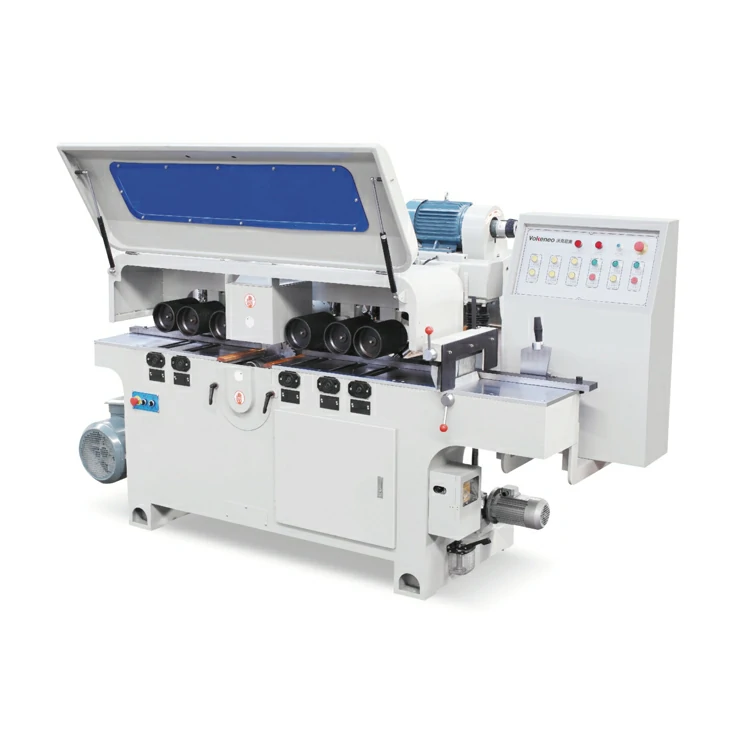
The series combines upper and lower saw spindles, a geared feeding drive, and separate spindle motors. These components form the cutting and feeding system. The catalog views below help identify the construction; supplied details should be checked against the final machine configuration.

Upper and Lower Saw Spindles
The two saw shafts work from opposite faces of the timber. The catalog describes thin-blade use and replaceable spacers, allowing the cutting arrangement to be prepared around the selected tooling

Geared Feeding
Drive
The feeding system uses a heavy-duty gearbox and a cardan shaft drive. Both models have a listed 2.2 kW feeding motor and a stepless feed range of 5–12 m/min.

Separate Upper and Lower Spindle Motors
The VK-J9420 has an 18.5-kW motor on each saw shaft. The VK-J9430 has a 22-kW motor on each shaft. Evaluate motor capacity together with cutting width, timber thickness, and the intended blade arrangement.

Operator Control Panel
The catalog machine has a dedicated control panel beside the working area. Confirm the supplied controls and adjustment functions during the configuration review, and use the operating manual for setup and operation.
- Model Comparison
VK-J9420 vs VK-J9430: Compare Cutting Width and Power
The main differences are maximum cutting width and spindle motor power. Both models share a cutting thickness range of 15–120 mm, a minimum working length of 450 mm, and a stepless feed speed of 5–12 m/min. Start with the required cutting width, then check the tooling, power supply, and installation space.
VK-J9420: Up to 200 mm Cutting Width
Consider the VK-J9420 when the required cutting width is within 200 mm. Its upper and lower saw shafts each have an 18.5 kW motor. Check the blade setup and workpiece dimensions before confirming suitability.
VK-J9430: Up to 300 mm Cutting Width
Consider the VK-J9430 when the required cutting width exceeds 200 mm and is within 300 mm. Each saw shaft has a 22 kW motor. It also requires more installation space than the VK-J9420.
Specification
VK-J9420
VK-J9430
Maximum cutting width
200 mm
300 mm
Maximum cutting thickness
120 mm
120 mm
Minimum cutting thickness
15 mm
15 mm
Minimum working length
450 mm
450 mm
Spindle speed
4,200 r/min
4,200 r/min
Spindle diameter
Ø50 mm
Ø50 mm
Saw blade diameter × bore
Ø205 × Ø50 mm
Ø205 × Ø50 mm
Feed speed
5–12 m/min, stepless
5–12 m/min, stepless
Upper saw shaft motor
18.5 kW
22 kW
Lower saw shaft motor
18.5 kW
22 kW
Feeding motor
2.2 kW
2.2 kW
Total power, catalog-listed
40.7 kW
47.7 kW
Air pressure
0.6 MPa
0.6 MPa
Overall dimensions, L × W × H
2,850 × 1,100 × 1,650 mm
2,900 × 1,250 × 1,650 mm
Packing dimensions, L × W × H
2,950 × 1,200 × 1,700 mm
3,000 × 1,350 × 1,750 mm
Weight
1,750 kg
1,980 kg
*Specifications are taken from the 2024 product catalog and are subject to final configuration confirmation. Cutting width is not a statement of maximum pass-through workpiece width. Catalog total power is not a measure of actual energy consumption during production.
Need More Than 200 mm Cutting Width?
Review the VK-J9430 first. A wider model does not automatically provide a higher finished-parts output per hour; the material, cutting pattern, and handling process still matter.
- Applications
Solid Wood Preparation for Furniture and Timber Components
Assess this series for lengthwise ripping of prepared solid wood into strips or component blanks. The examples below describe potential production tasks, subject to material and tooling review. The relevant workpiece must meet the selected model’s dimensional limits before it enters the cutting process.

Furniture Component
Blanks
Prepare solid wood strips for later sizing, planing or profiling. Confirm the required section size and machining allowance so the ripping setup suits the next operation.

Door and Frame
Stock
Evaluate the machine used to prepare timber blanks for door and frame production. Ripping establishes the strip widths; later machining creates the finished component geometry.

Repeated Timber Strip Production
Prepare batches of strips from suitable timber for downstream woodworking processes. Review timber condition, target widths, and batch size before selecting the blade arrangement and feed setting.
Send material details before requesting a configuration for round logs, sheet materials, unusually wet timber, or other special stock. Suitability for those materials is not established by the listed dimensional specifications alone.
- For thickness preparation, explore our Double-Sided Planer Machine.
- For subsequent profiling, explore our Seven-Axis Four-Side Wood Planer.
- For length cutting, explore our Optimizing Cut-Off Saw Machine.
The production sequence should be planned around the material and finished component requirements
- Selection Checklist
What to Prepare Before Selecting Your Rip Saw
Accurate machine selection starts with the timber and finished strip requirements. Share the information below so the cutting width, blade arrangement, and installation requirements can be reviewed together. A sample drawing or a clearly labeled photo of the workpiece is helpful when the cutting pattern is complex.
Material and Dimensions
Provide the wood species, moisture condition and incoming length, width and thickness ranges. Identify the shortest and thickest workpieces in the batch.
Finished Strips and Cutting Pattern
List the required strip widths, quantities and any allowance for planing or profiling. Include the dimensional tolerance and surface condition needed at the next operation.
Production and Handling
State the expected output, typical batch size and how material will be loaded and collected. Mention existing conveyors or other equipment that may need to connect to the saw.
Installation and Purchasing Requirements
Provide the destination country, voltage and frequency, available floor space, compressed-air supply and dust-extraction arrangements. Importers and distributors can also identify documentation and spare-parts requirements for their market.
Will This Rip Saw Fit Your Timber and Strip Sizes?
Share your wood species, incoming timber dimensions, and required strip widths. LINKYOU can help review whether the VK-J9420 or VK-J9430 suits your cutting task and discuss the blade setup and handling requirements.
- Buyer FAQ
Frequently Asked Questions About the VK-J9420 and VK-J9430
Use these answers to check the main selection boundaries before requesting a quotation. They cover model differences, automation, tooling, and site requirements. Material suitability and the final supplied configuration should be reviewed against your production task.
What is the difference between the VK-J9420 and VK-J9430?
The VK-J9420 has a maximum cutting width of 200 mm and two 18.5-kW saw-shaft motors. The VK-J9430 increases the maximum cutting width to 300 mm and uses two 22-kW saw-shaft motors. Both list a cutting thickness of 15–120 mm, a minimum working length of 450 mm, and a feed speed of 5–12 m/min.
Does “automatic” include loading and stacking?
The listed machine capability includes powered feeding through the cutting process. Automatic loading, outfeed sorting, or stacking should not be assumed from the product name. Those functions require a separately reviewed line configuration.
How are the strip widths changed?
Strip widths are set through the blade and spacer arrangement. The catalog describes replaceable spacers, but does not establish automatic moving-blade positioning for these models. Confirm the tooling arrangement and changeover procedure for your required widths.
How many strips can be produced in one pass?
There is no single strip quantity that applies to every job. It depends on the usable timber width, required strip widths, saw kerf, trimming allowance, and approved blade arrangement. Submit a cutting pattern for a configuration review.
Is a dual-spindle saw the same as a double-arbor saw?
For this machine, the terms describe an upper and a lower saw shaft. Each shaft carries the blades used in the cutting setup. Check the actual shaft arrangement when comparing products, because suppliers may use different category names.
Can it process hardwood and softwood?
This series is presented for solid wood preparation. Suitability for a particular hardwood or softwood depends on the species, moisture condition, dimensions, blade setup, and cutting load. Send your material details for review instead of selecting solely based on the stated maximum thickness.
What cutting accuracy can I expect?
The referenced catalog page does not specify a finished-strip dimensional tolerance. Agree on the required tolerance, timber condition, tooling, feed setting, and measurement method before confirming a production test. A positioning figure alone should not be treated as a finished-cut tolerance.
What air supply and dust extraction are required?
Both models list an air pressure of 0.6 MPa. The catalog page does not provide air consumption, extraction airflow, or duct specifications. Confirm those requirements with the machine configuration before sizing the site services.
What is needed for a quotation?
Provide the preferred model, timber dimensions, wood species, required strip widths, target output, destination, and electrical supply. Tooling, shipping scope, documentation, and any line-handling requirements should be confirmed in the quotation.
- Technical Inquiry
Find the Right Multi-Blade Rip Saw for Your Timber
Tell LINKYOU what you need to cut and the strip sizes you want to produce. Share your material and production requirements to discuss the VK-J9420 or VK-J9430, the required blade setup, and the quotation scope.
For a useful first review, include the wood species, incoming dimensions, target strip widths, and destination country. If you are unsure which model to choose, send the requirements you already have.