
VK-L9616SM / VK-L9620SM
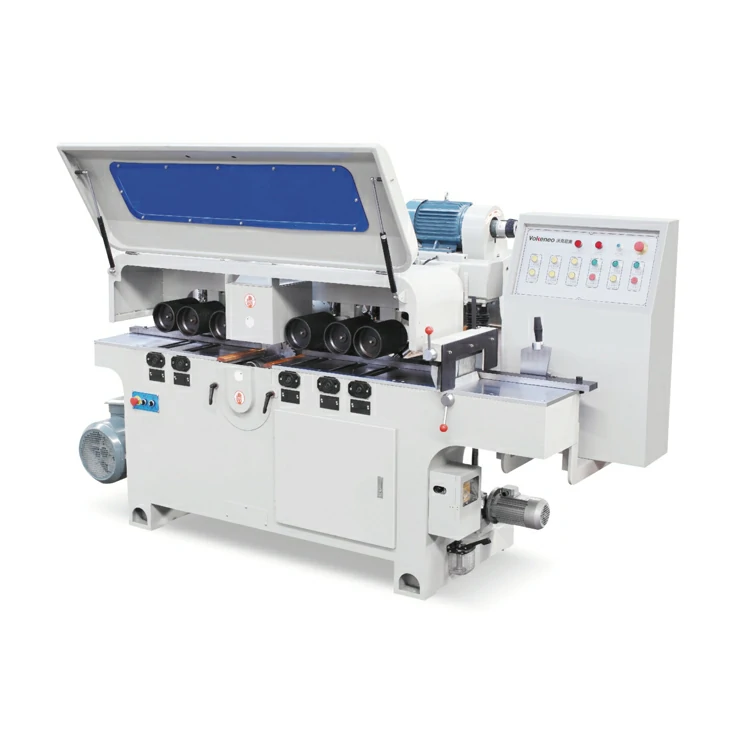
Four-Side Planer Saw Machine
Four-Side Planing with Horizontal Resawing
Combine four-side planing and horizontal resawing in one feed pass. The VK-L9616SM and VK-L9620SM prepare the outer faces of solid wood and use opposed left and right saw units to produce thinner boards. Choose a working width of 30–160 mm or 30–200 mm to suit your timber
- 160 / 200 mm Maximum Working Width
- 10–120 mm Working Thickness
- 600 mm Minimum Length
- 8–20 m/min Feed Speed
- Quick Answer
“What Is a Four-Side Planer Saw Machine?
A four-side planer saw machine combines four-side planing and horizontal resawing in one feed pass. It planes the timber’s four outer faces, then uses opposed left and right saw units to divide suitable solid wood into thinner boards. The VK-L9616SM and VK-L9620SM share this process, with working widths of 30–160 mm and 30–200 mm respectively. Choose the model based on your timber dimensions and the board thicknesses you need to produce.
- Key Features
Combine Four-Side Planing and Resawing in One Pass
Bring surface preparation and horizontal resawing into the same machine. For suitable repeat-production tasks, this arrangement can reduce transfers between separate planing and sawing stations. The practical result depends on your timber, required board thicknesses, and tooling setup.
Prepare the Outer Faces Before Resawing
Plane the top, bottom, and both edges of the workpiece as part of the combined process. The new faces created by resawing remain sawn surfaces and may need further finishing for the next operation.
Cut from Both Sides of the Workpiece
Opposed left and right saw units cut into the timber from both sides. The horizontal cutting layout divides suitable stock through its thickness to produce thinner boards.
Adjust Feeding to the Cutting Task
Adjust the feed speed within 8–20 m/min to match the timber, tooling, and cutting load. Both models share this feed range, allowing the operating setting to be selected for the production task.
- Working Principle
How Four-Side Planing and Horizontal Resawing Work
A four-side planer saw combines outer-face planing with lengthwise resawing. In this series, the saw units approach the timber from the left and right sides. The resulting cuts separate the workpiece into thinner boards through its thickness, rather than cutting it to length.

Conceptual process diagram. Tooling arrangement and output depend on the approved configuration.
Feed Suitable
Timber
Check the incoming width, thickness, length, and condition against the selected model and tooling setup. Present the timber to the machine’s feeding system as specified in the operating instructions.
Plane the Four Outer Faces
The planing units machine the outer surfaces of the timber. Allow for the material removed during planing when specifying the required resawn board sizes.
Resaw from the Left and Right
The opposing saw units make the horizontal lengthwise cuts shown in the catalog process diagram. The approved blade arrangement determines the cut levels and the number of boards produced.
Receive and Inspect the Boards
Check the resawn thickness and surface condition against your production requirements. Plan any sanding, further planing, or profiling required after this operation
- Machine Details
A Closer Look at the Planing, Sawing and Feeding Units
Both models share the same core process: four-side planing, opposed horizontal sawing, and roller feeding. The component views below illustrate the series construction. Compare the specifications for the saw sizes and motor ratings of each model.

Opposed Left and Right Saw Units
The series uses two saw drives in an opposed-cutting arrangement. The VK-L9616SM lists 18.5 kW × 2 saw motors; the VK-L9620SM lists 22 kW × 2 saw motors. Blade diameter ranges also differ between the models.

Side Planing
Cutter
The side cutter machines an outer edge as part of four-side preparation. Select tooling based on the wood species, machining allowance, and finish required before resawing.

Roller Feeding
System
Feed rollers move the timber through the combined process. Both models list a 5.5 kW feeding motor. Feeding settings and workpiece support should be matched to the approved material and cutting setup.
- Models & Technical Data
VK-L9616SM vs VK-L9620SM: Specifications and Model Selection
Choose the model first based on your required working width: 30–160 mm for the VK-L9616SM or 30–200 mm for the VK-L9620SM. Both models use the same planing and resawing process and share a 10–120 mm working thickness range, a 600 mm minimum working length, and an 8–20 m/min feed speed. Saw blade sizes, motor ratings, and machine dimensions differ as shown below.
VK-L9616SM: 30–160 mm Working Width
Consider the VK-L9616SM for timber within the listed working width of 30–160 mm. It uses two 18.5 kW saw motors and a listed saw blade diameter range of 205–255 mm.
VK-L9620SM: 30–200 mm Working Width
Choose the VK-L9620SM for a working width range of 30–200 mm, including workpieces wider than the VK-L9616SM range. It uses two 22-kW saw motors and saw blades with diameters of 280–305 mm.
Specification
VK-L9616SM
VK-L9620SM
Working width
30–160 mm
30–200 mm
Working thickness
10–120 mm
10–120 mm
Minimum working length
600 mm
600 mm
Cutter spindle diameter
Ø40 mm
Ø40 mm
Saw shaft diameter
Ø50 mm
Ø50 mm
Saw blade diameter
Ø205–255 mm
Ø280–305 mm
Feed speed
8–20 m/min
8–20 m/min
Cutter spindle speed
7,000 r/min
7,000 r/min
First lower trimming cutter diameter
Ø125 mm
Ø125 mm
First lower cutter diameter
Ø125 mm
Ø125 mm
Total motor power
72.75 kW
79.75 kW
Saw spindle motor power
18.5 kW × 2
22 kW × 2
Feeding motor power
5.5 kW
5.5 kW
Beam lifting motor power
0.75 kW
0.75 kW
Air supply pressure
0.6 MPa
0.6 MPa
Overall dimensions, L × W × H
3,800 × 1,500 × 1,700 mm
3,800 × 1,600 × 1,700 mm
- Specifications are taken from the 2024 catalog and require confirmation against the supplied configuration. Working thickness is not the minimum thickness of a resawn board. A dash reproduces an unspecified catalog entry and does not specify the adjustment method.
- Total motor power is not a measure of actual energy consumption during operation.
Which Planer Saw Fits Your Timber?
Compare the 160 mm and 200 mm maximum working widths, then share your timber dimensions and target board thicknesses. We’ll help you assess the model and tooling for your production needs.
- Applications
Solid Wood Preparation for Cladding and Resawn Boards
The catalog identifies solid wood preparation for wall panels and timber used in preservative-treated products. The combined process can be evaluated wherever outer-face planing and horizontal resawing are both required. Confirm the wood condition, target board thickness, and downstream machining before selecting a setup.

Wall Cladding and Panelling Stock
Prepare solid wood blanks for cladding and paneling production. Resawing establishes thinner board sections; any finished profile, joint, or coating requires the appropriate later operation.

Door and Frame
Stock
Evaluate the machine used to prepare timber blanks for door and frame production. Ripping establishes the strip widths; later machining creates the finished component geometry.

Repeated Timber Strip Production
Prepare batches of strips from suitable timber for downstream woodworking processes. Review timber condition, target widths, and batch size before selecting the blade arrangement and feed setting.


Check a Sample Against Your Requirements
A useful sample comparison records the wood species, moisture condition, incoming dimensions, blade setup and feed speed. Measure the output thickness at agreed positions and inspect the sawn surfaces before confirming the production setup.
- Optional Units & Selection
Discuss Tooling Options and Line Requirements
Start configuration planning with your timber and finished board requirements. The series catalog lists carbide cutter options and an optional sanding arrangement. Availability of the selected model, supplied tooling, and any handling equipment must be agreed upon in the final configuration.
Cutterhead and Saw Blade Selection
Discuss conventional carbide or spiral cutter options for the planing operation. Confirm the saw blade arrangement separately, including target board thicknesses, kerf allowance, and the required cutting pattern.
Optional Sanding Arrangement
The series catalog includes an optional sanding arrangement. Confirm its installation, working scope, and model compatibility before adding it to the order. It should not be assumed to finish every newly sawn face.
Infeed, Outfeed and Site Services
Describe how timber reaches the machine and how the resawn boards will be collected. Review electrical supply, compressed air, extraction connections, and handling space alongside any proposed conveyors or loading equipment.
Choose the process around the result you need
Production requirement
Equipment to evaluate
Four outer faces need planing, with no resawing requirement
A four-side planer or moulder
Four-side planing and horizontal resawing are both required
VK-L9616SM / VK-L9620SM, subject to setup review
Prepared timber needs ripping into narrower strips
A suitable multi-blade rip saw
Frequent changes require independent planing and resawing schedules
Separate machines, compared against a combined setup
Need a Planer Saw Setup for Your Timber?
Share your wood species, incoming timber dimensions, and target board thicknesses. LINKYOU will help you assess the suitable model, tooling options, and infeed or outfeed requirements for your production.
- Buyer FAQ
Questions About Four-Side Planing and Resawing
Check the differences between the models, the resawing process, and the information needed for a quotation. These answers help define a suitable application before the final tooling and machine configuration are agreed upon.
What is the difference between a four-side planer and a four-side planer saw?
A four-side planer machines the outer faces of a timber workpiece. This four-side planer saw combines that preparation with opposed left and right saw units for horizontal resawing. Choose the combined process when your production task needs both operations.
Does this machine cut timber to length?
The documented saw arrangement makes lengthwise cuts to divide timber through its thickness. It is not a crosscutting unit for cutting boards to a specified length. Discuss a separate cut-off operation if length sizing is required.
What is the difference between VK-L9616SM and VK-L9620SM?
The models share the same core process. The VK-L9616SM handles a working width of 30–160 mm; the VK-L9620SM handles 30–200 mm. Saw blade diameters, motor power, and overall dimensions also differ. Both share a 10–120 mm working thickness range, 600 mm minimum working length and 8–20 m/min feed speed.
What is the minimum thickness of the resawn boards?
The referenced catalog does not specify a minimum finished board thickness. Its 10 mm figure is the lower limit of working thickness, not a resawn output specification. Submit the required board thickness and cutting pattern for tooling and sample review.
How many boards can it produce in one pass?
There is no confirmed universal output count. It depends on the prepared workpiece thickness, blade arrangement, saw kerf, and target board sizes. The term opposed sawing does not mean that every setup produces exactly two boards.
Are all output surfaces planed?
Four-side planing machines the workpiece’s four outer faces. Surfaces newly created by resawing are sawn surfaces. Further planing or sanding may be required depending on the finished product and agreed quality requirements.
Can it process hardwood, softwood or treated timber?
Suitability depends on species, moisture, treatment condition, dimensions, and tooling. Send those details for review. A general solid-wood application or dimensional limit should not be treated as approval for all materials.
What accuracy and production output can I expect?
The referenced catalog does not state a finished-board tolerance or guaranteed hourly output. Agree on the material, blade setup, feed setting, measurement method, and acceptance criteria for a production test. Feed speed alone is not a guarantee of finished output.
Does the machine include automatic loading and stacking?
The catalog specifications cover the combined planer saw and its feeding system. Automatic loading, board separation, conveyors, and stacking require a separately agreed-upon handling configuration.
What site services are required?
Both models list an air supply pressure of 0.6 MPa. Air consumption, extraction airflow, duct sizes, and final electrical connection requirements need to be confirmed for the supplied configuration. Allow space for timber handling and servicing beyond the machine dimensions.
What determines the four-side planer saw price?
The quotation depends on the model, tooling, confirmed options, electrical specifications, documentation, and delivery scope. Provide your destination, incoming timber sizes, and target board thicknesses so the quotation can address your actual production task.
- Technical Inquiry
Request a Planer Saw Configuration for Your Timber
Tell LINKYOU what timber you process and the board thicknesses you want to produce. Share the incoming dimensions, wood species, and production requirements to discuss the VK-L9616SM or VK-L9620SM and the scope of the quotation.
For a useful first review, include timber length × width × thickness, target output thicknesses, wood condition, and destination country. A labeled cross-section sketch can help explain a multi-board cutting pattern.