
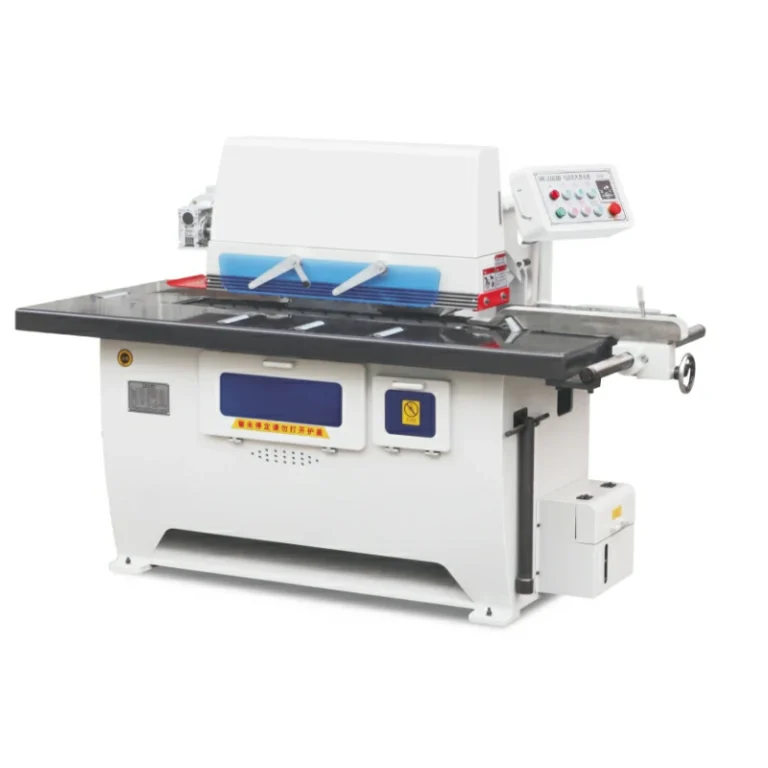
VK-J163B Straight-Line Rip Saw
Bottom-Spindle Single-Blade Ripping for Solid Wood
Straighten an edge or rip solid wood to a selected width with powered chain feeding and a bottom-mounted saw spindle. The VK-J163B handles cutting thicknesses of 10–90 mm, cutting widths up to 460 mm, and workpieces up to 230 mm long, with an adjustable feed speed of 10–33 m/min.
10–90 mm Cutting Thickness
460 mm Maximum Cutting Width
230 mm Minimum Length
10–33 m/min Feed Speed
- Quick Answer
“What Is a Straight-Line Rip Saw?
A straight-line rip saw uses a circular saw blade and powered feed to make a controlled lengthwise cut through solid wood. It is commonly used to straighten one edge or rip a board to a selected width before later planing, molding, gluing, or multi-rip processing. The VK-J163B uses a liftable bottom spindle, so the blade cuts upward from below the worktable.
- Key Features
Built for Controlled Single-Blade Ripping
The VK-J163B combines a single bottom saw blade with powered chain feeding for repeated edge-straightening and width-ripping tasks. Its practical performance depends on the timber, blade, feed setting, pressure adjustment, and material handling used for the job.
Powered Chain Feeding
The feed system carries the workpiece through the cutting area at a selected speed. This supports a repeatable production rhythm without treating the machine as an automatic loading or stacking line.
Liftable Bottom Spindle
The saw spindle is positioned below the worktable and can be raised or lowered for the approved cutting setup. Confirm the blade diameter, projection, and adjustment procedure for the material being processed.
Adjustable Feed from 10 to 33 m/min
Match the feed setting to the wood species, moisture condition, thickness, blade, and required cut surface. The listed maximum feed speed is not a guaranteed output for every material.
Alignment and Workpiece Control
The catalog shows an infrared alignment device, a powered pressure-mechanism lift, and anti-kickback structures. These help the operator prepare and control the cut; they do not provide scanning or automatic yield optimization.
- Working Principle
How the VK-J163B Makes a Straight Lengthwise Cut
The saw blade rises from below the worktable while the feed chain moves the timber through the cutting area. The operator selects and aligns the intended cut line before feeding. One blade creates a single longitudinal cut line per pass; loading, turning, and outfeed handling are separate tasks unless additional equipment is confirmed.

Conceptual process illustration. The operator selects the cutting line; scanning and automatic cut optimization are not available for this model.
Check the Timber and Cutting Plan
Confirm the incoming length, width, thickness, wood condition, and the required edge or finished width. Select the approved saw blade and prepare the machine according to its operating instructions.
Align the Intended Cut Line
Set the guide and pressure arrangement for the workpiece. Use the catalog-shown infrared alignment device to help position the planned cut before the board enters the cutting zone.
Feed the Board through the Saw
Powered chain feeding advances the timber over the bottom-mounted blade at the selected speed. The blade makes one lengthwise cut during the pass.
Receive and Check the Ripped Board
Support the material at the outfeed and inspect the edge, width, and surface condition against the next operation. A second pass may be used for another operator-selected cut when appropriate.
- Machine Details
A Closer Look at the VK-J163B Feeding and Cutting System
The catalog component views show how the series feeds, aligns, presses, and lubricates the workpiece and machine. Use current VK-J163B photographs wherever possible, and confirm the final supplied brands and component specifications in the quotation.

Powered Chain Feed for Controlled Workpiece Travel
Toothed chain-feed blocks carry the timber through the cutting area at the selected feed speed. Powered feeding reduces reliance on manually pushing the workpiece throughout the cut and supports a steadier operating rhythm during repeated straight-line ripping.
Feeding stability still depends on suitable timber, correct pressure adjustment, clean chain blocks, and proper tracking of the feed mechanism. The chain path and wear condition should therefore be included in routine inspection and maintenance.
Bottom-Mounted Blade with a Liftable Saw Spindle
The circular saw blade operates beneath the worktable and produces a single longitudinal cut line with each feed pass. The catalog lists a Ø50.8 mm saw shaft, a spindle speed of 2,930 r/min, and a saw blade diameter range of Ø355–455 mm.
The liftable spindle allows the blade position to be set for the approved cutting arrangement. Blade diameter, kerf, tooth geometry, and blade projection should be selected based on the wood species, material thickness, and required cut surface.


Powered Pressure-Mechanism Adjustment
The pressure mechanism helps keep the timber engaged with the feeding path while it moves through the cutting area. Its height adjustment is motor-driven, reducing the need to reposition the mechanism entirely by hand when changing between suitable workpiece thicknesses.
The catalog also shows upper- and lower-limit switches for the adjustment movement. The operator must still set the mechanism around the actual timber thickness and condition; this feature should not be described as automatic thickness detection or automatic pressure optimization.
Variable Feed Speed from 10 to 33 m/min
The inverter-controlled feeding system allows the operating speed to be adjusted within the catalog-listed range of 10–33 m/min. This allows the operator to select a feed setting based on the timber species, moisture condition, cutting thickness, saw blade, and the required surface condition.
The maximum feed setting should not be treated as the correct speed or guaranteed production rate for every workpiece. Cutting load and result quality should be checked when establishing the production setting.


Infrared Reference for Cut-Line Alignment
The infrared alignment device projects a visible reference that helps the operator position the intended cutting line before feeding the timber. It can be used when selecting an edge to remove or aligning the board for the required ripping width.
This is an operator alignment aid. It does not scan for wood defects, calculate material yield, automatically reposition the guide, or provide software-based cutting optimization.
Microcomputer-Controlled Forced Lubrication
The catalog shows a microcomputer-controlled lubrication pump that supplies lubricant to designated machine components according to the required maintenance schedule. This supports more consistent lubrication of the relevant moving and guiding parts.
The system does not make the machine maintenance-free. The correct lubricant, lubrication points, operating settings, and service intervals should follow the current machine manual supplied with the final configuration.


Dual Anti-Kickback Structures at the Feed Path
The catalog shows two anti-kickback structures positioned to help resist unintended backward movement of the timber during feeding. They work together with the pressure mechanism, feeding system, and other machine safeguards.
Anti-kickback components should not be presented as an absolute guarantee against workpiece movement. Correct stock selection, adjustment, guarding, inspection and trained operation remain necessary.
Wear-Resistant Double-Guide Feed Structure
The catalog identifies a wear-resistant double-guide arrangement within the feeding system. Its role is to support and guide the moving feed assembly as the timber travels toward and through the cutting area.
The guide structure contributes to the operation of the feed path, but it does not by itself establish a finished-edge tolerance. Cutting results also depend on the blade, timber condition, pressure setting, alignment, and maintenance of the complete feeding and cutting system.

Will the VK-J163B Match Your Timber?
Send your wood species, incoming length × width × thickness, required finished widths, and expected production volume. LINKYOU can review whether the VK-J163B single-blade straight-line ripping process is suitable for your material and cutting requirements.
- Technical Data
VK-J163B Technical Specifications
Use the dimensional range to make an initial suitability check, then review the timber, blade, cut quality, and site services together. A listed maximum describes the catalog machine limit; it does not guarantee the same result for every wood species or cutting condition.
10–90 mm Cutting Thickness
460 mm Maximum Cutting Width
230 mm Minimum Cutting Length
10–33 m/min Feed Speed
Specification
VK-J163B
Machine type
Bottom-spindle single-blade straight-line rip saw
Cutting thickness
10-90 mm
Maximum cutting width
460 mm
Minimum cutting length
230 mm
Maximum saw blade diameter
Ø355-455 mm
Saw shaft diameter
Ø50.8 mm
Spindle speed
2,930 r/min
Feed speed
10-33 m/min
Main motor power
11kW
Feed motor power
1.5 kW
Pressure-mechanism lifting motor
0.25 kW
Total power
12.75kW
voltage
380 V
Working table size
1,820 x 970 mm
Overall size, L x W x H
2,100 x 1,600 x 1,450 mm
Packing size, L x W x H
2,200 x 1,700 x 1,550 mm
Weight
1,600 kg
Dust outlet diameter
1 x Ø150 mm + 1 x Ø100 mm
Specifications are taken from the 2024 product catalog and are subject to confirmation of the current configuration. Cutting thickness and width do not, by themselves, establish suitability for a wood species, moisture condition, or required finish. Confirm electrical data, dust extraction, blade specification, and installation clearances before ordering.
- Applications
Four Straight-Line Ripping Applications
The VK-J163B can be used for straight-line edge trimming and repeated width ripping of suitable solid wood. The diagrams below illustrate four operator-planned cutting approaches. Each black line represents a cutting position completed in a separate feed pass; the machine does not automatically scan the timber or calculate the cutting pattern.

Straight Edge Trimming
Remove irregular or unwanted material from the board edges to establish straighter reference edges for subsequent sizing or machining. Trimming both sides requires separate alignment and feed passes.

Width-Based Straight-Line Ripping
Position the board according to the required widths and complete each longitudinal cut in a separate pass. The cutting positions can be planned around the required component sizes and available board width.

Selective Ripping Around Usable Material
The operator can select cutting positions based on visible timber quality and the required component dimensions. This can help recover suitable sections from the board, but the cutting plan is determined by the operator rather than by an automatic optimization system.

Re-Ripping a Remaining Wide Section
After the first cutting operation, the remaining wide section can be repositioned and fed through the machine for another longitudinal cut, provided it remains within the approved working range and can be safely supported.
- Configuration & Site Requirements
Configure the VK-J163B for Your Timber and Installation Site
The VK-J163B should be specified around the timber, cutting plan, and installation conditions rather than by model number alone. Before ordering, confirm the saw blade, electrical supply, chip extraction, workpiece support, and maintenance clearance. The catalog lists an 11 kW saw motor and a total motor power of 12.75 kW; final connections and supplied accessories must follow the approved configuration.
Saw Blade and Cutting Setup
The catalogue lists a Ø355–455 mm saw blade range and a Ø50.8 mm saw shaft. Select the blade diameter, kerf and tooth design based on the wood species, material condition, cutting thickness and required cut quality. The blade specification and whether a blade is included should be stated clearly in the final quotation.
Electrical Configuration
Provide the available voltage, frequency, and phase at the installation site. The catalog lists 11 kW for the saw motor and 12.75 kW for the total motor power, but the final control voltage, cable connections, and electrical protection requirements must follow the approved electrical documentation.
Dust Extraction and Chip Removal
Connect the machine to a suitable dust extraction system to remove sawdust and chips from the cutting area. Confirm the number and diameter of extraction outlets, required airflow, static pressure, and dust-collector capacity against the current machine configuration before installation.
Infeed, Outfeed and Workpiece Support
Plan stable support for the longest and heaviest timber to be processed. Infeed and outfeed tables, roller supports, conveyors, and collection equipment should be discussed separately, as they are not assumed to be included with the standard machine.
Machine Position and Service Clearance
Install the machine on a level, load-bearing floor, and allow sufficient space for timber loading and unloading, blade changes, cleaning, and routine maintenance. Confirm the machine weight, load points, anchoring method, and service clearances using the current installation or general-arrangement drawing.
Information Needed for Configuration Review
Share the following information so the cutting setup, site requirements, and quotation scope can be reviewed before the order is finalized.
Review item
Information from the buyer
Items to confirm
Timber
Wood species, moisture or treatment condition
Material suitability and blade selection
Incoming material
Length × width × thickness and edge condition
Fit within the approved working range
Cutting task
Edge trimming or required finished widths
Cutting plan, blade, and number of passes
Production target
Required output per shift and batch pattern
Practical setup and handling requirements
Electrical supply
Voltage, frequency, and phase
Motor, controls and connection specification
Dust extraction
Existing collector and duct arrangement
Outlet size, airflow and static pressure
Material handling
longest timber, and outfeed collection
Tables, rollers, conveyors, or other line equipment
Installation site
Available floor area and layout
Footprint, service clearance and positioning
Request a VK-J163B Configuration and Quotation
Send your timber dimensions, required cutting widths, production target, power supply, and destination country. LINKYOU can review the cutting setup, site requirements, and quotation scope for your project.
- Buyer FAQ
Frequently Asked Questions About the VK-J163B
These answers explain the machine type, dimensional limits, automation boundary, tooling, and site requirements. Final suitability and supplied configuration should be confirmed for the actual material and production task.
Is the VK-J163B a straight-line rip saw or a multi-blade rip saw?
It is a bottom-spindle, single-blade straight-line rip saw. One blade creates one longitudinal cut line per feed pass. A multi-blade rip saw carries several blades to produce multiple parallel cuts in a single pass, so it is a different category of machine.
What material sizes can the VK-J163B process?
The catalog lists a cutting thickness of 10–90 mm, a cutting width of up to 460 mm, and a minimum cutting length of 230 mm. Suitability also depends on the wood species, moisture condition, straightness, blade, and cutting requirements.
Is the saw blade mounted above or below the worktable?
The VK-J163B uses a bottom-mounted saw spindle. The blade rises from below the worktable to make the lengthwise cut while the powered feed system advances the timber.
How many cuts does the machine make in one pass?
The machine uses a single saw blade, so it makes one longitudinal cut per pass. Additional edges or widths require another suitable pass or a different machine configuration.
Does the VK-J163B scan the board and optimize lumber yield automatically?
The referenced catalog does not establish a scanner, defect-recognition system, optimization software, or automatic moving guide for this model. The operator selects and aligns the cutting line. Do not interpret the catalog cutting-strategy graphics as proof of automatic optimization.
Can it produce a glue-ready edge directly from the saw?
The catalog does not specify a glue-line tolerance or finished-edge accuracy for the VK-J163B. Required straightness, surface quality, and measurement method should be agreed upon before a sample test. Further jointing or planing may be needed for the next process.
Can it cut both hardwood and softwood?
The machine is designed for solid-wood ripping, but its suitability for a specific hardwood or softwood depends on species, moisture content, dimensions, defects, blade geometry, feed rate, and cutting load. Send the material details for review.
How should the saw blade and feed speed be selected?
The catalog lists a blade diameter range of Ø355–455 mm and a feed rate of 10–33 m/min. The final blade, kerf, tooth geometry, and feed setting should be selected based on the material and required cut surface, following the machine and tooling instructions.
Does powered feeding include automatic loading and unloading?
No. Powered feeding refers to moving the presented workpiece through the cutting area. Automatic loading, turning, return conveying, sorting, or stacking should not be assumed unless separately confirmed in the project scope.
What electrical and dust-extraction services are required?
The catalog lists 380 V and two dust outlets: one Ø150 mm and one Ø100 mm. It does not provide extraction airflow, static pressure, full-load current, or alternative voltage details on the referenced page. Confirm these data before site preparation.
What determines the VK-J163B price?
The quotation depends on the confirmed machine configuration, electrical requirements, scope of blades and spare parts, documentation, destination, shipping terms, and any required handling equipment or services. Send the timber and project information for a comparable quotation.
- Technical Inquiry
Request a VK-J163B Straight-Line Rip Saw Configuration
Tell LINKYOU what you need to cut and the required result after ripping. Share your timber dimensions, wood species, target width, destination, and site requirements so the VK-J163B and quotation scope can be reviewed.
For a useful first review, include the minimum and maximum workpiece sizes, a labeled photo or drawing of the material, the required edge quality, the typical batch size, and the electrical supply.